
Ties and impossible criteria: finish the specification
On this page 2 headings
A calculation can be mechanically correct while the problem rules remain incomplete. Three physical prize slots cannot always fit everyone tied at the boundary. Representation rules can also be impossible if no eligible student belongs to a required category.
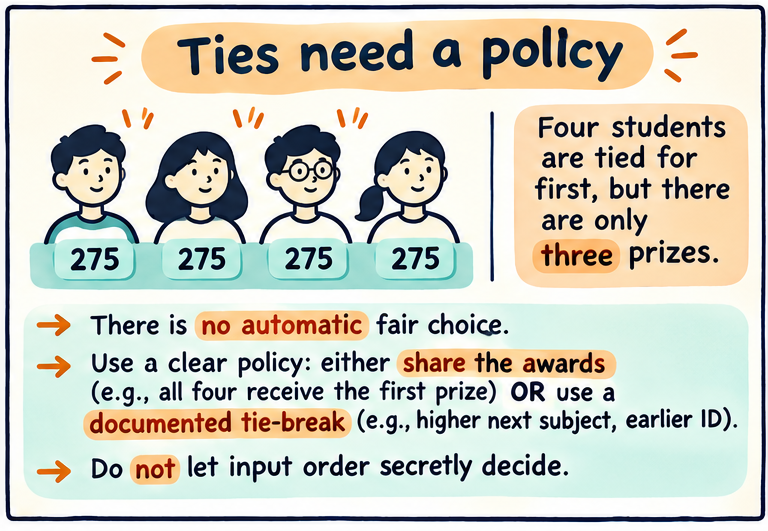
Separate score levels from prize slots
| Situation | Can three prize slots include everyone shown? |
|---|---|
| Three students tied for first | Yes: all three can receive a prize. |
| Four students tied for first | No: choose a stated tie-break or allow more prizes. |
| One first; two students tied for second | Yes: three people in total. |
| One first; three students tied for second | No: four people are competing for three slots. |
A deterministic display order such as CardNo does not automatically make an award policy fair. Say whether ties lead to shared prizes, another documented criterion, or a request for a revised rule. Do not silently let the input order decide.
Check representation after eligibility
Our three actual winners include M and F, so no adjustment is needed. In a different dataset, one approach is to replace the lowest selected person with the highest eligible person from the missing category. If no such eligible person exists, the current rules are infeasible. Repeating a search without a failure condition will not create a valid candidate.
The lecture discusses excluding a lowest selected person and repeating. Each attempt must make progress and terminate when eligible possibilities are exhausted. Never remove a required condition silently to force an answer.
Try it yourself
Can four first-place ties all fit three prizes?
Show explained answer
No. The rules need a tie policy or permission to award more than three prizes.
Try it yourself
What if no eligible F record exists under a rule requiring M and F?
Show explained answer
Report that the requirements cannot all be met. Further identical scans will not help.
Try it yourself
Is using input order as an unstated tie-break acceptable?
Show explained answer
No. It produces an arbitrary outcome that changes if the cards are shuffled.
Try it yourself
Do the actual winners satisfy the lecture’s representation rule?
Show explained answer
Yes. Rahul is M; Deepika and Abirami are F.