
Write a contract: inputs, result and allowed changes
On this page 2 headings
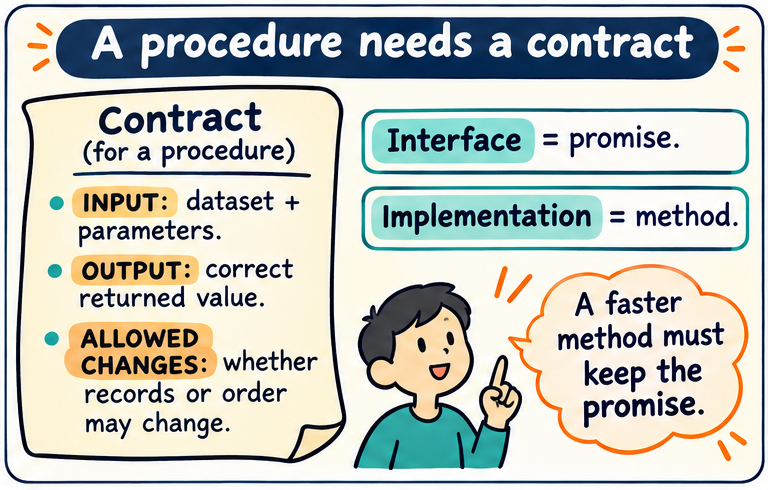
A procedure’s interface is the boundary between caller and helper. Its contract states what the caller supplies, what the helper returns, and what changes to the input are permitted. The implementation is how the helper performs the work.
| Contract part | Example: SumMarks |
|---|---|
| Inputs | A nonempty or empty score dataset, a valid Gender value, and a valid numeric field name. |
| Result | The sum of that field for all matching records; zero if no rows match. |
| Data integrity | Do not change marks, IDs or records. |
| Order policy | Preserve the original order, or explicitly document if order may change. |
Replace the method while preserving the promise
If you improve one procedure, every call can benefit without rewriting the main code. But the new version must preserve the agreed input meaning, result and side-effect policy. Returning the same number is insufficient if the new version unexpectedly destroys a carefully sorted deck.
Some tasks depend on the sequence
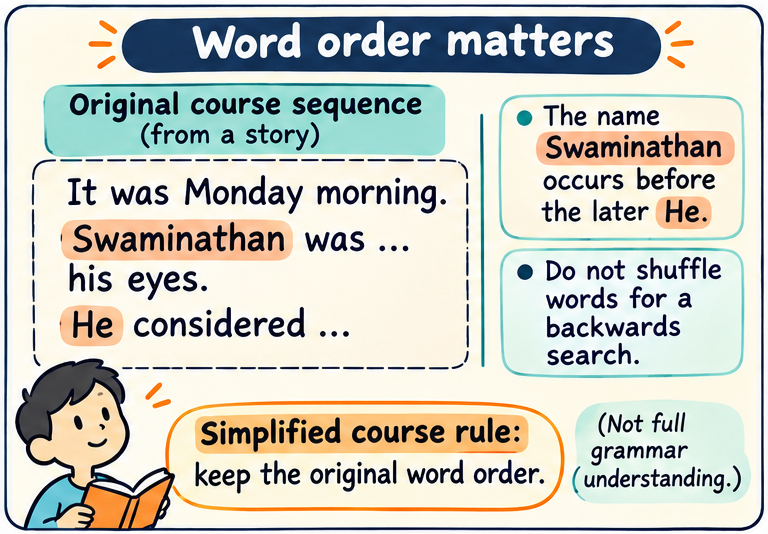
For a text-search exercise, a pronoun such as He can be associated with a preceding name by a backwards-search rule. In the supplied paragraph, Swaminathan occurs before the later He. Shuffling the word records destroys the “before” relation. Preserve SerialNumber and order when using such a rule.
Nearest preceding name is a simplified course heuristic, not a complete English-language pronoun resolver. A PartOfSpeech label of Noun alone does not prove that a word is a person’s name; apply the rule specified by the task.
Example contract for a text search:
Input: a pronoun position and the ordered words before/after it
Output: a matching name under the stated search rule, or "not found"
Allowed changes: none to words, IDs, or order
A reading-only loop over table rows need not move the rows at all. Card-pile pseudocode makes movement visible; real implementations must still make their data-change promises explicit.
Try it yourself
What is the difference between interface and implementation?
Show explained answer
The interface is the agreement the caller relies on. The implementation is the internal method used to meet it.
Try it yourself
May a faster procedure violate its old order guarantee?
Show explained answer
No. It must preserve the full contract, including allowed changes.
Try it yourself
Why is shuffling word cards dangerous for a backwards search?
Show explained answer
It changes which words come before the pronoun and can change the answer.
Try it yourself
Must every procedure return a useful number?
Show explained answer
No. Some procedures act by updating or rearranging data.