
Understand the need.
Define the software.
An illustrated guide to gathering requirements, understanding stakeholders, and writing specifications and user stories.
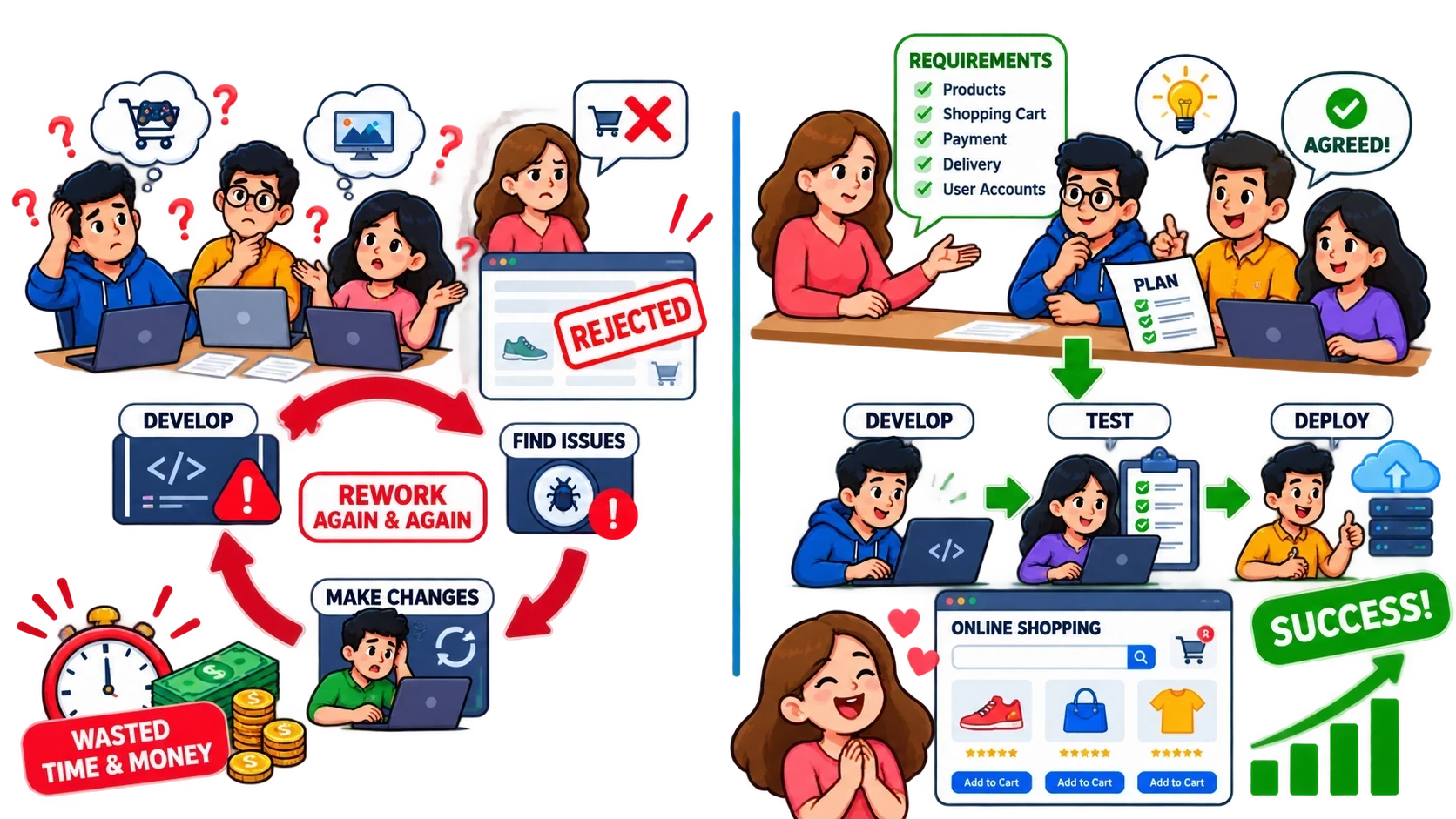 WHY REQUIREMENTS MATTER
Study sections
Follow the order or choose a sectionWhy do requirements matter?
If we do not spend sufficient time and effort identifying and documenting requirements, there is a mismatch between what the user expec…
02Who should we ask? Stakeholders and users
When a software system is introduced it influences different types of users — from your own organisation, other organisations or end us…
03Requirement analysis: spotting problems
During requirements analysis, we analyse the gathered requirements to form a clear understanding of the exact customer requirements and…
04Five ways to gather requirements
Users identified for the Seller Portal: independent sellers, sales team/manager of companies, advertising department, logistics/shippin…
05Questionnaires and interviews
A series of questions designed to elicit specific information from users. Answers can be yes/no, a choice from a set of answers, or a l…
06Focus groups, observation and existing documents
Drawback of interviews: they offer only one perspective. Alternative: get a group of stakeholders to discuss issues and requirements. A…
07Practical guidelines and sample portal features
After requirement gathering, the Seller Portal could contain the following features.
08Functional versus non-functional requirements
Captures a functionality required by the users from the system: the user performs actions/gives inputs and the system provides an appro…
09Reliability, robustness and other quality requirements
Reliability is the extent to which a program behaves the same way over time in the same operating environment. E.g. the software should…
10What is an SRS?
In the Plan and Document perspective, requirement gathering and analysis is usually done by a system analyst, with other members of the…
11What kinds of interfaces appear in an SRS?
Broad high-level functions, each with its functional requirements. For the Seller Portal:
12Why use an SRS?
13Plan and Document versus Agile requirements
The SRS serves as an agreement between customers and developers. But in many projects customers are unsure of the requirements, and the…
14Behaviour-Driven Design (BDD)
Behaviour Driven Design (BDD) asks questions about the behaviour of an application before and during development, so that stakeholders…
15The user-story template
User stories are short, informal, plain-language descriptions of what a user wants to do within a software product, which is of value t…
16Why are user stories useful?
17SMART user stories
A good user story should be SMART: Specific, Measurable, Achievable, Relevant and Timeboxed.
18SMART: how to improve a story
Vague: “User can search for a product in the catalogue” → specific: “User can search for a product by title in the catalogue”.
19User-story limits and choosing an approach
1. Continuous contact with customers may be difficult or too expensive — customers may not want to participate or may not be available…
Revision and practice
Review and practice materialWhat this guide covers: Five Week 2 sections and the complete 66-slide teaching deck, including source examples and the SMART user-story criteria.