Computational thinking means turning a problem into clear steps that another person or a computer can follow. This course begins before any particular programming language. You will learn to organize information, recognize useful patterns, and check that your procedure does what you intended.
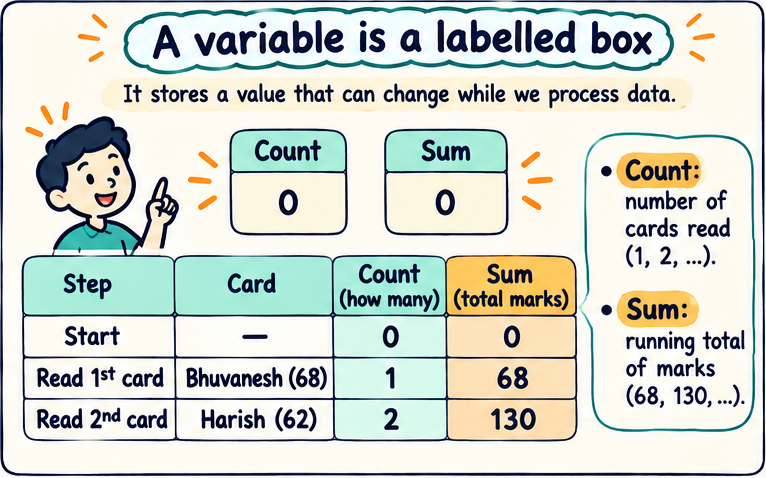
A variable remembers a changing value. Count and Sum answer different questions.
YOUR COURSE DATA · TRY IT HERE
Count the score cards
Use the supplied 30 score cards. No download or coding is needed.
READY TO START
A pile of 30 cards
Start with the first card. Read its fields, do one small action, then move on.
▱ ▱ ▱
What we remember
Read
0
Nothing has been read yet. Choose Next card to begin.
Look through all 30 original records
BhuvaneshMaths 68 · Erode
CardNo
0
Name
Bhuvanesh
Gender
M
DateOfBirth
7 Nov
CityTown
Erode
Mathematics
68
Physics
64
Chemistry
78
Total
210
HarishMaths 62 · Salem
CardNo
1
Name
Harish
Gender
M
DateOfBirth
3 Jun
CityTown
Salem
Mathematics
62
Physics
45
Chemistry
91
Total
198
ShashankMaths 57 · Chennai
CardNo
2
Name
Shashank
Gender
M
DateOfBirth
4 Jan
CityTown
Chennai
Mathematics
57
Physics
54
Chemistry
77
Total
188
RidaMaths 42 · Chennai
CardNo
3
Name
Rida
Gender
F
DateOfBirth
5 May
CityTown
Chennai
Mathematics
42
Physics
53
Chemistry
78
Total
173
RitikaMaths 87 · Madurai
CardNo
4
Name
Ritika
Gender
F
DateOfBirth
17 Nov
CityTown
Madurai
Mathematics
87
Physics
64
Chemistry
89
Total
240
AkshayaMaths 71 · Chennai
CardNo
5
Name
Akshaya
Gender
F
DateOfBirth
8 Feb
CityTown
Chennai
Mathematics
71
Physics
92
Chemistry
84
Total
247
SameerMaths 81 · Ambur
CardNo
6
Name
Sameer
Gender
M
DateOfBirth
23 Mar
CityTown
Ambur
Mathematics
81
Physics
82
Chemistry
87
Total
250
AdityaMaths 84 · Vellore
CardNo
7
Name
Aditya
Gender
M
DateOfBirth
15 Mar
CityTown
Vellore
Mathematics
84
Physics
92
Chemistry
76
Total
252
SuryaMaths 74 · Bengaluru
CardNo
8
Name
Surya
Gender
M
DateOfBirth
28 Feb
CityTown
Bengaluru
Mathematics
74
Physics
64
Chemistry
51
Total
189
ClarenceMaths 63 · Bengaluru
CardNo
9
Name
Clarence
Gender
M
DateOfBirth
6 Dec
CityTown
Bengaluru
Mathematics
63
Physics
88
Chemistry
73
Total
224
KavyaMaths 64 · Chennai
CardNo
10
Name
Kavya
Gender
F
DateOfBirth
12 Jan
CityTown
Chennai
Mathematics
64
Physics
72
Chemistry
68
Total
204
RahulMaths 97 · Bengaluru
CardNo
11
Name
Rahul
Gender
M
DateOfBirth
30 Apr
CityTown
Bengaluru
Mathematics
97
Physics
92
Chemistry
92
Total
281
SrinidhiMaths 52 · Chennai
CardNo
12
Name
Srinidhi
Gender
F
DateOfBirth
14 Jan
CityTown
Chennai
Mathematics
52
Physics
64
Chemistry
71
Total
187
GopiMaths 65 · Madurai
CardNo
13
Name
Gopi
Gender
M
DateOfBirth
6 May
CityTown
Madurai
Mathematics
65
Physics
73
Chemistry
89
Total
227
SophiaMaths 89 · Trichy
CardNo
14
Name
Sophia
Gender
F
DateOfBirth
23 July
CityTown
Trichy
Mathematics
89
Physics
62
Chemistry
93
Total
244
GoutamiMaths 76 · Theni
CardNo
15
Name
Goutami
Gender
F
DateOfBirth
22 Sep
CityTown
Theni
Mathematics
76
Physics
58
Chemistry
90
Total
224
TauseefMaths 87 · Trichy
CardNo
16
Name
Tauseef
Gender
M
DateOfBirth
30 Dec
CityTown
Trichy
Mathematics
87
Physics
86
Chemistry
43
Total
216
ArshadMaths 62 · Chennai
CardNo
17
Name
Arshad
Gender
M
DateOfBirth
14 Dec
CityTown
Chennai
Mathematics
62
Physics
81
Chemistry
67
Total
210
AbiramiMaths 72 · Erode
CardNo
18
Name
Abirami
Gender
F
DateOfBirth
9 Oct
CityTown
Erode
Mathematics
72
Physics
92
Chemistry
97
Total
261
VetrivelMaths 56 · Trichy
CardNo
19
Name
Vetrivel
Gender
M
DateOfBirth
30 Aug
CityTown
Trichy
Mathematics
56
Physics
78
Chemistry
62
Total
196
KalyanMaths 93 · Vellore
CardNo
20
Name
Kalyan
Gender
M
DateOfBirth
17 Sep
CityTown
Vellore
Mathematics
93
Physics
68
Chemistry
91
Total
252
MonikaMaths 78 · Bengaluru
CardNo
21
Name
Monika
Gender
F
DateOfBirth
15 Mar
CityTown
Bengaluru
Mathematics
78
Physics
69
Chemistry
74
Total
221
PriyaMaths 62 · Nagercoil
CardNo
22
Name
Priya
Gender
F
DateOfBirth
17 Jul
CityTown
Nagercoil
Mathematics
62
Physics
62
Chemistry
57
Total
181
DeepikaMaths 97 · Bengaluru
CardNo
23
Name
Deepika
Gender
F
DateOfBirth
13 May
CityTown
Bengaluru
Mathematics
97
Physics
91
Chemistry
88
Total
276
SiddharthMaths 44 · Madurai
CardNo
24
Name
Siddharth
Gender
M
DateOfBirth
26 Dec
CityTown
Madurai
Mathematics
44
Physics
72
Chemistry
58
Total
174
GeetaMaths 87 · Chennai
CardNo
25
Name
Geeta
Gender
F
DateOfBirth
16 May
CityTown
Chennai
Mathematics
87
Physics
75
Chemistry
92
Total
254
JKMaths 74 · Chennai
CardNo
26
Name
JK
Gender
M
DateOfBirth
22 Jul
CityTown
Chennai
Mathematics
74
Physics
71
Chemistry
82
Total
227
JaganMaths 81 · Madurai
CardNo
27
Name
Jagan
Gender
M
DateOfBirth
4 Mar
CityTown
Madurai
Mathematics
81
Physics
76
Chemistry
52
Total
209
NishaMaths 74 · Madurai
CardNo
28
Name
Nisha
Gender
F
DateOfBirth
10 Sep
CityTown
Madurai
Mathematics
74
Physics
83
Chemistry
83
Total
240
NaveenMaths 72 · Vellore
CardNo
29
Name
Naveen
Gender
M
DateOfBirth
13 Oct
CityTown
Vellore
Mathematics
72
Physics
66
Chemistry
81
Total
219
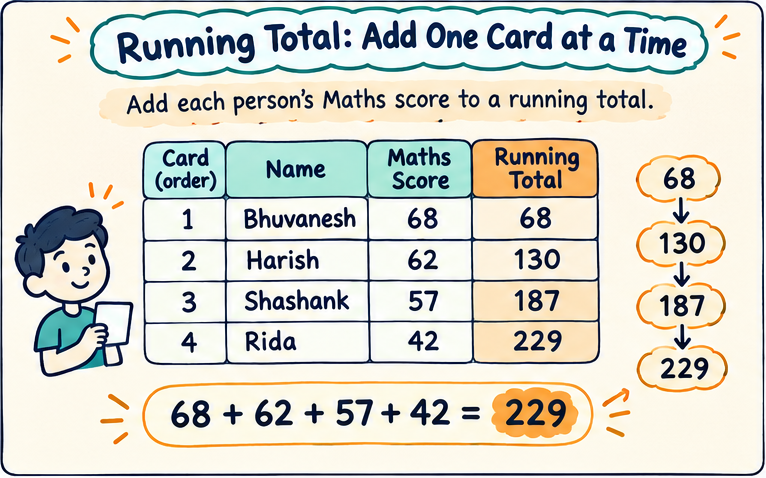
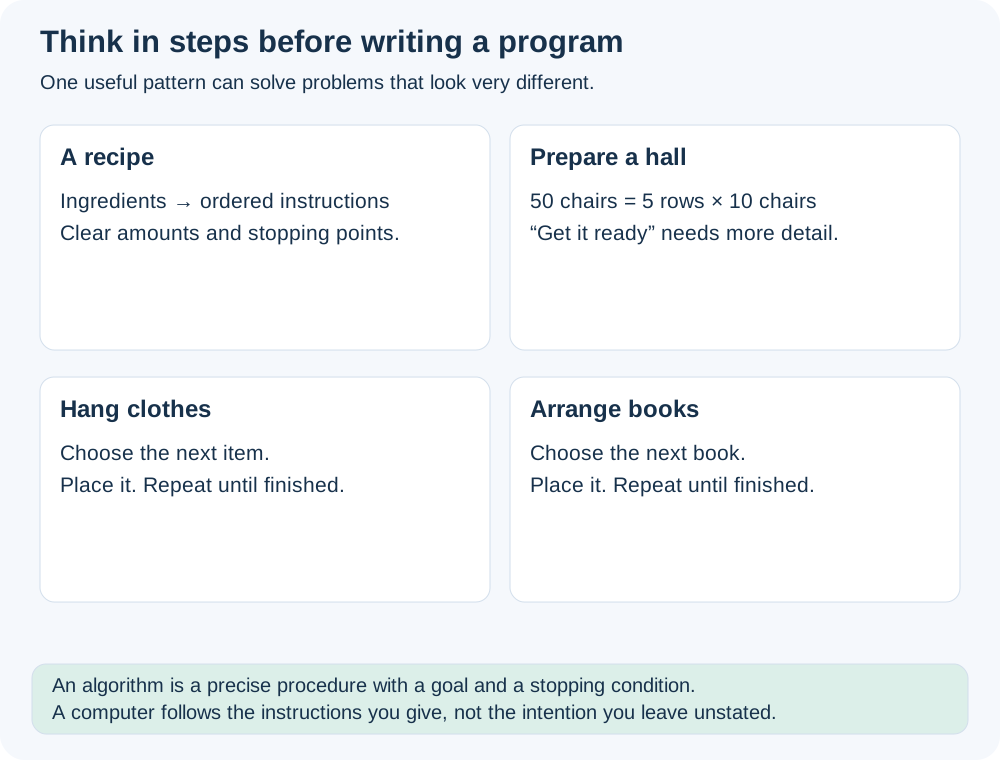
The first four actual score cards show a running sum of 68, 130, 187 and 229.A precise procedure can be reused across recipes, preparing a hall, hanging clothes and arranging books.
“Prepare the hall for 50 guests” leaves many decisions unstated. A beginner may need: clean the hall, arrange 5 rows of 10 chairs, leave an aisle, and finish before the event starts. The amount of detail depends on what the person or machine already knows how to do.
An algorithm is a systematic procedure for solving a problem. It states what information is needed, which steps to perform, when to make a choice, what to repeat, and when to stop. A computer executes the specified steps; it does not fill gaps using human common sense.
For clothes, repeatedly choose an item and put it on a line. For books, repeatedly choose a book and place it on a shelf. The objects differ, but the repeated “choose, process, move on” structure is similar. The lecture’s largest-first arrangement is an example of a strategy, not a guarantee of the best packing for every situation.
Filters, combined conditions and separate group summaries.
Draw the procedure
Flowcharts, decisions and loop arrows.
Trust the inputs
Sanity checks and missing or inconsistent data.
Describe the data
Basic types, subtypes, representations, records and lists.
Try it yourself
Why is “sort these books nicely” an incomplete instruction?
Show explained answer
“Nicely” does not state a rule. Specify the order, such as by title or height, how to choose the next book, and when the procedure is finished.
Try it yourself
Do you need to know Python to understand a card-counting procedure?
Show explained answer
No. You can explain and execute the steps by hand first. A programming language can express the same procedure later.
Try it yourself
Which stopping condition fits “move every card to a second pile”?
Show explained answer
Stop when the original pile is empty. That condition can be checked after each completed move.
Try it yourself
Does a similar procedure require identical objects?
Show explained answer
No. The same scan-and-update pattern can count students, words or shopping bills. Change the record fields and the update rule to match the task.
Source: Lecture 0 — Introduction to course. Small teaching datasets and diagrams are prepared for these notes; lecture and tutorial totals are identified explicitly.