
Linear maps and the limits of exact preservation
On this page 7 headings
Learning goal: See why reducing dimension requires approximate preservation.
- The ideaShine a torch on a stick and look at its shadow on the floor.
- The shadow is a 2D version of a 3D object.
- Tilt the stick so it points straight at the torch and its shadow becomes a dot: its length is lost completely.
- Any squeeze from more dimensions to fewer must crush some direction like this.
- So keeping every length exactly is impossible.
- JL asks for less: keep lengths approximately, and only for your n points.
- Key statementThe picture of JL: n points in (red blob) mapped by f to (blue blob).
- The distance is compared with , with the 1 − ε and 1 + ε bounds and .
Step 1: try the simplest kind of map, a matrix
- linear transformations, so .
- Greedy wish: for every u.
- Then
Wish: ?
Why can we focus on single vectors u when JL is about pairs?
Because a distance is a length: is the length of the vector .
For a matrix, , so preserving the lengths of difference vectors is the same as preserving distances.
- "Linear transformation" just means "multiply by a matrix".
- For the wish to hold for every u, we need to be the identity matrix.
Step 2: rotations show it is possible when
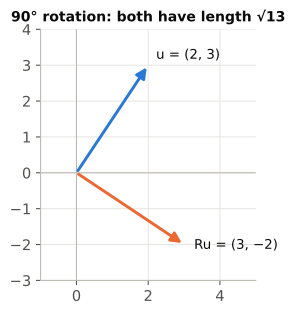
Worked example
- Clockwise 90° rotation: .
- For u = (2, 3): Ru = (3, −2).
- Lengths: and .
- Same.
- Check: .
- But a rotation keeps us in the same dimension (2 → 2).
- It does no dimension reduction, so it is useless for our goal.
Step 3: with , the wish fails
- Key statementWrite the rows of (= columns of R) as , each in .
- Then entry (i, j) of is .
- For we need and for i ≠ j, i.e.
- orthonormal in .
- Exact preservation is impossible when k < d. → aim for an approximate "isometry".
Linear algebra fact: in k dimensions you can have at most k mutually perpendicular unit vectors.
In 2D you can't draw 3 arrows that are all at right angles to each other.
We need d of them in with d > k.
Impossible.
Isometry = a map that keeps all distances exactly.
We have just shown no k × d matrix with k < d is an isometry.
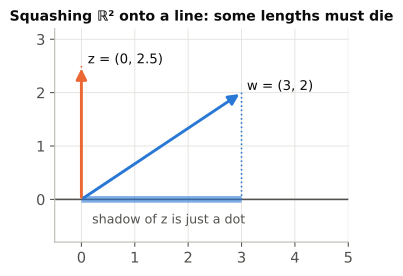
A second proof: some vector always gets crushed to zero
- A k × d matrix with k < d gives k equations in d unknowns for .
- With more unknowns than equations, there is always a nonzero solution u.
- That u has but : its length is completely destroyed.
- Example: (1 × 2) and give .
Step 4: the two relaxations that save us
- Approximate, not exact. We accept the 1 ± ε factor ("approximate isometry").
Only n points, not the whole space. We only need to preserve the pairwise distances of our data, not the length of every vector in .
The points can be anything, but there are only finitely many of them.
Check yourself
What size is if R is 3 × 10?
(10 × 3)(3 × 10) = 10 × 10.
Find a nonzero u that R = [1 1 1] sends to 0.
Any u with entries summing to 0, e.g. (1, −1, 0).
Key points to remember
- A k × d matrix maps d input coordinates to k output coordinates.
- When , some nonzero vector must map to zero.
- JL asks for approximate preservation of selected pairs, rather than exact preservation of every vector.