
SECTION 07 / 10
Johnson–Lindenstrauss lemma
On this page 4 headings
Learning goal: Understand what dimensionality reduction must preserve.
Conditions to check
- Big-O describes growth and does not determine a numerical target dimension without an explicit constant.
- The distortion factor applies to squared distances.
- A worst-case dimension guarantee can exceed the original dimension, in which case it offers no reduction.
- The ideaYou have a million points, each described by 10,000 numbers.
- All you care about is how far apart the points are, for example to find nearest neighbours.
- JL says you can describe each point with far fewer numbers and still have every pairwise distance correct to within, say, 10 %.
- The magic: how few numbers you need depends on how many points you have, not on how many numbers you started with.
JL lemmaGiven n points in a high-dimensional space and an error parameter , there exists a mapping with such that for all x, y among the n points:
Reading it slowly
- n points in : your data set; d is huge.
- f: a recipe that turns each d-dimensional point into a k-dimensional one.
ε: how much distortion you accept.
With ε = 0.1, every squared distance after mapping is between 0.9× and 1.1× the original.
: the new dimension.
It grows with log n (slowly) and with (halving the error needs 4× the dimensions). d does not appear at all.
"There exists" means the lemma promises such an f exists.
Lesson 8 shows that a random matrix works.
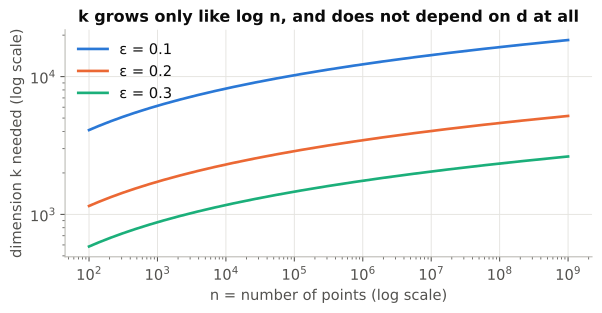
Key statement, , ε = 0.1:
and the guarantee becomes , with .
Check yourself
If ε halves (0.2 → 0.1), how does k change?
k ∝ 1/ε², so it multiplies by 4.
If n grows from 10⁶ to 10¹² (squared), how does k change?
- log n doubles, so k (roughly) doubles.
- A million times more points, only twice the dimension.
Does increasing d from 10⁴ to 10⁸ change k?
No. k does not depend on d.
Key points to remember
- JL preserves squared distances approximately for a finite set of points.
- The target dimension grows with and .
- Big-O alone does not give an exact numerical dimension.