
Test the behavior.
Build confidence.
48 lessons with 47 illustrations cover test design, pytest, TDD, integration and system testing, followed by revision questions and practice problems.
 SOFTWARE TESTING & QUALITY
Study sections
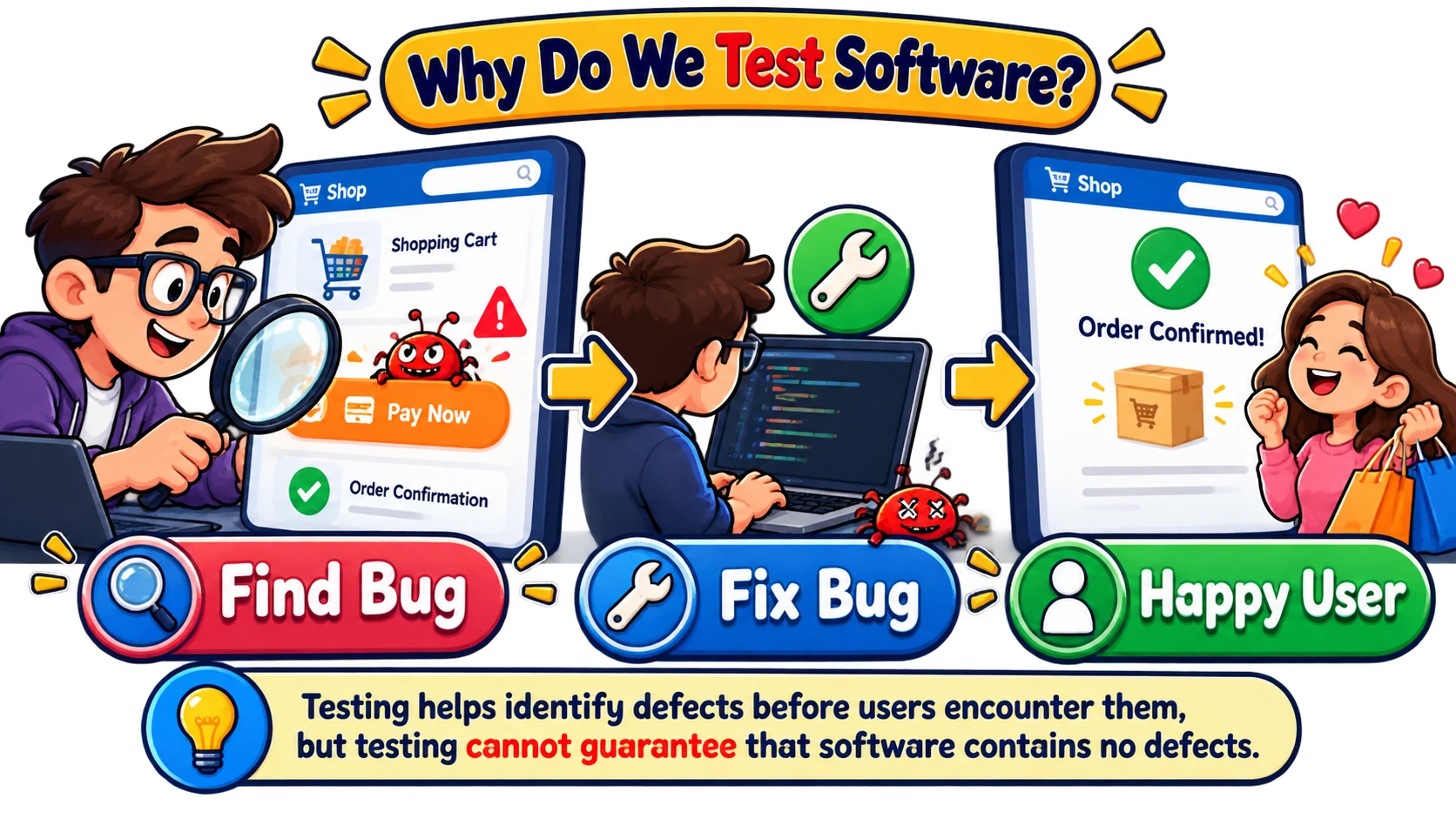
Follow the order or choose a sectionWhy Do We Test Software?
Even simple errors such as integer overflow can crash entire systems. Airport system failures and spacecraft crashes show why software…
02Errors Can Crash Entire Systems
Integer overflow, an airport system failure and a spacecraft crash illustrate the consequences of software errors.
03Building the Right Thing vs Building It Right
Earlier weeks focused on finding the right requirements and communicating with clients: building the right thing.
04Basic Activities in Testing
Provide inputs; check the output; see whether it matches expectations; locate the error; identify its cause; fix the error; test again.…
05What Is a Test Case?
A test case is the triplet [I, S, R]. I is the data input to the program; S is the state of the program at which that data is input; R…
06Test Case vs Test Suite
A test suite is the set of all test cases designed to test a given program.
07Why Design Test Cases?
Random tests do not guarantee that most errors will be found. Consider the faulty minimum calculation: if (x < y) min = x; else min = x…
08Can We Test Every Input?
The input domain is too large to test exhaustively. Design a minimal test suite in which each test case detects a different type of err…
09Levels of Software Testing
Unit testing tests individual functions or units. Integration testing incrementally combines units and tests them after each step.
10Unit vs Integration Testing
Unit testing checks an individual unit. Integration testing detects errors at module interfaces, including parameter passing and commun…
11Alpha vs Beta Testing
Alpha testing is performed by the test team within the organisation. Beta testing is performed by a select group of customers on the fu…
12Acceptance Testing
The customer checks whether the system meets the requirements or user stories and decides whether to accept delivery.
13Black-box Testing
Black-box testing is also called functional testing. Treat the program as a black box and design tests by examining input and output va…
14Equivalence Class Partitioning
Partition the input domain into equivalence classes: the program behaves similarly for every input in a class. Select one representativ…
15Equivalence Classes for min(x, y)
For x < y, min(3, 8) returns 3. For x > y, min(9, 4) returns 4. For x = y, min(5, 5) returns 5. Each pair represents one equivalence cl…
16Equivalence Classes for isPrime(num)
isPrime(num) takes a positive integer. Its equivalence classes are prime numbers, which should return True, and non-prime numbers, whic…
17Boundary Value Analysis
Programmers may confuse for i in range(n) with range(n-1), or < with <=. Examine values at the boundaries of equivalence classes. For i…
18Boundary Cases for is_prime()
For isPrime(num), 0 and 1 are boundary values and are not prime. The values 2 and 3 are prime.
19Designing Black-box Tests
From requirements or specifications, identify input and output structures and values. Identify equivalence classes. Choose one represen…
20White-box Testing
White-box testing is also called structural testing. Analyse the structure of the program using heuristics such as coverage. Test cover…
21Black-box vs White-box Testing
Black-box testing is functional testing: use input and output values. White-box testing is structural testing: examine the program stru…
22Branch Coverage
Branch coverage requires every branch to be taken at least once. For min(x, y), one test has x < y and another has x >= y.
23Testing Both Branches of min(x, y)
With (3, 8), x < y is True and the result is 3. With (9, 4), x < y is False and the result is 4.
24Branch Coverage: is_prime()
The test suite {0, 2, 3, 4} guarantees branch coverage for the lecture’s isPrime code.
25Multiple Condition Coverage
In multiple condition coverage, each component of a composite condition takes True and False values. For num == 0 or num == 1, the inpu…
26Branch vs Multiple Condition Coverage
For if (num < 50 || num > 150), {49, 100} achieves branch coverage. The set {49, 100, 200} achieves multiple condition coverage. Multip…
27Control-Flow Graph
In a control-flow graph, nodes represent line numbers and an edge means control flows from one line to another. For path coverage, the…
28Independent Paths in is_prime()
The lecture’s independent paths are {1, 2, 3} for 0 or 1; {1, 2, 4, 7} for 2; {1, 2, 4, 5, 6} for the non-prime 4; and {1, 2, 4, 5, 4,…
29Cyclomatic Complexity
Cyclomatic complexity is the number of decision and loop statements plus 1. Here it is 3 + 1 = 4: four independent paths, requiring at…
30Why Unit Testing Matters
Other modules may not be ready when a module is written. Testing a unit separately also makes debugging easier because the module conta…
31Unit Testing During Development
WHEN: during coding of the module, rather than waiting for the testing phase. WHO: the person writing the code. WHAT: design unit test…
32Unit Testing Environment
The module under test may access non-local data and call functions that are not yet available, such as function_1, function_2 and funct…
33What Is a Stub?
A stub is a dummy procedure with the same input/output parameters as the function the module calls, with highly simplified behaviour.
34What Is a Driver?
A driver contains the non-local data structures accessed by the module under test and calls the module. A stub stands in for a function…
35Python Unit Testing Tools
unittest is part of Python’s built-in standard library. pytest is popular and minimises boilerplate code. Install it with pip install p…
36How pytest Finds Tests
The lecture names test files with the test_ prefix, such as test_seller_portal.py, and test functions with the test_ prefix. Without th…
37Understanding assert
An assertion checks a condition: assert actual == expected. If the comparison is False, Python raises AssertionError.
38Seller Portal Inventory
The lecture uses a Product class and a SellerInventory class. seller_inventory_map stores {product_id: count}. add_items_to_inventory a…
39Testing Inventory Addition
Add 10 items of product P1: seller_inventory_map[P1] is 10. Add 10 more: the expected count is 20.
40A Unit Test Catches a Bug
Forgetting the + replaces the count instead of adding to it. The second addition produces 10 instead of 20, causing AssertionError: 10…
41Testing Inventory Deletion
Add 10 items and delete 5. The expected remaining count is 5.
42pytest Fixtures: Reusable Setup
A fixture method such as inventory() initialises the object once for use in all test cases in the lecture example.
43Testing Expected Exceptions
Add 10 items and attempt to delete 20. A test using pytest.raises(ValueError) passes when ValueError is raised. If the test deletes onl…
44Traditional Development vs TDD
Traditionally, tests are written after the code. Test-driven development, used especially in Agile, writes tests first and drives desig…
45Red–Green–Refactor
RED: express the requirement as a test, run it and see it fail. GREEN: write the minimum code needed to pass. REFACTOR: make the code m…
46Building is_prime() with TDD
First test a non-prime such as 4: expect False. The test fails; add a loop that returns False when num % i == 0, then it passes.
47Testing is_prime(): Important Cases
The important cases are is_prime(5) → True, is_prime(4) → False, is_prime(2) → True, is_prime(1) → False and is_prime(0) → False.
48Integration and System Testing
Begin integration testing when a few or all modules have been unit-tested. The objective is to detect interface errors such as paramete…
Revision and practice
Review and practice material48 lessons cover testing, functional and structural techniques, unit testing, pytest, TDD, integration and system testing. Follow them with the mini revision questions and practice problems.